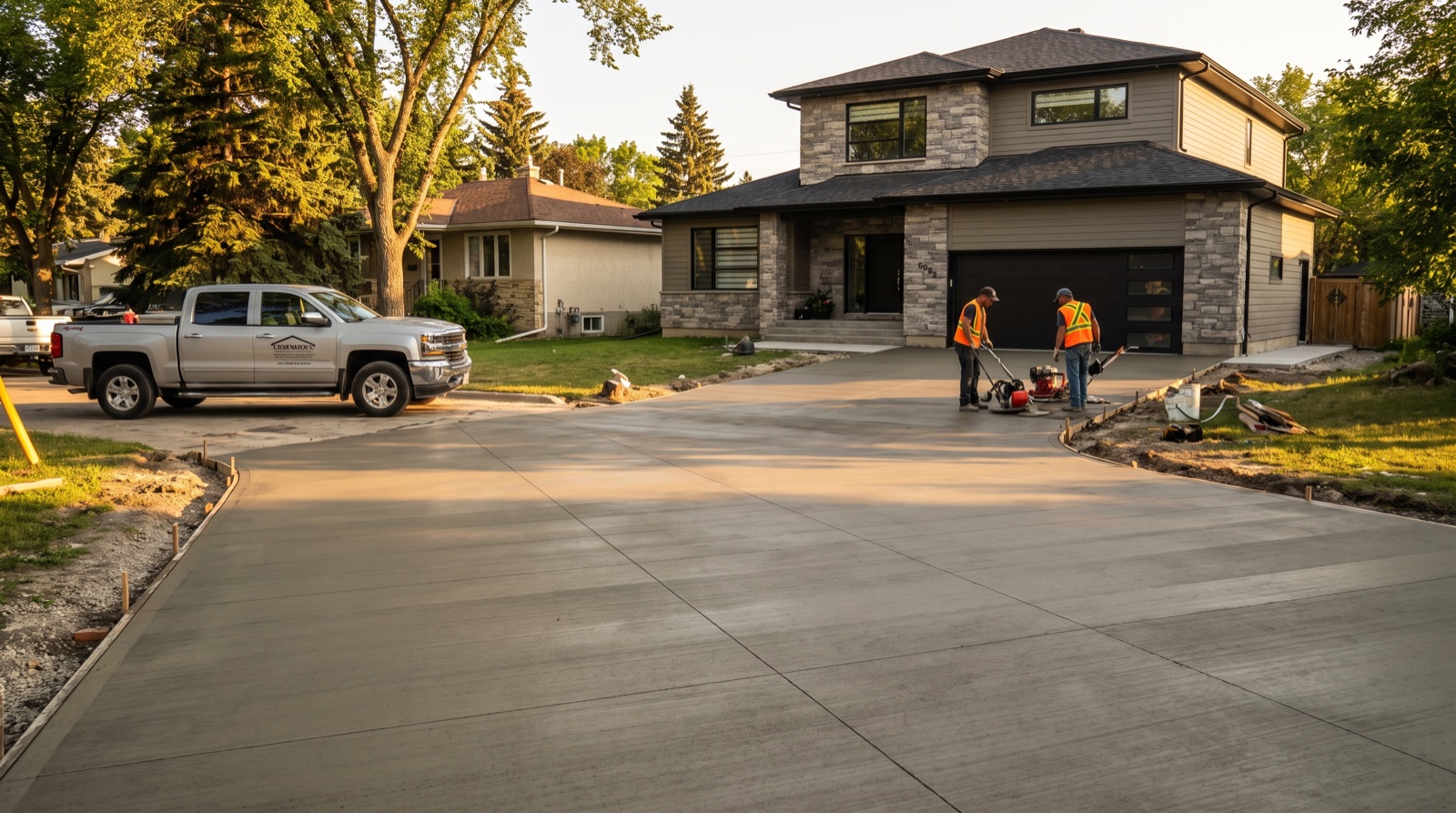
A properly installed concrete driveway lasts 30 to 50 years. In Winnipeg, where frost runs deep and road salt is part of life for five months of the year, reaching the upper end of that range depends on the base, the mix, and how well the surface is maintained.
Most driveways that fail early do so because of a shortcut on pour day or because nobody ever sealed them. Both problems are avoidable.
What Determines Driveway Lifespan
The 30 to 50 year range is wide because the variables are significant. Four of them matter more than anything else.
Base preparation
Winnipeg sits on heavy clay that swells when wet and shrinks when dry. A compacted granular base at least six inches deep gives the slab a stable, draining layer so it does not move with the clay underneath.
Concrete mix and thickness
Exterior concrete in Manitoba should be 32 MPa with air entrainment of 5 to 8 percent. Those microscopic air bubbles give freezing water room to expand, which prevents the surface from scaling.
A residential slab should be at least four inches thick, and five inches or more where heavy trucks or trailers park. Rebar or wire mesh keeps any cracks tight if they form.
Finishing and curing
Concrete that is overworked, finished with added water, or allowed to dry too fast ends up with a weak top layer. That layer is the first thing to flake off after a few winters.
Drainage
Water that pools on the slab or runs beneath it shortens its life. The driveway should slope away from the house, and downspouts should discharge clear of the slab edges.
If you are planning a new pour, ask your contractor how each of these is handled. A driveway that is built properly needs far less attention later.
Expected Lifespan by Condition
| Scenario | Typical lifespan |
|---|---|
| Good base, proper mix, sealed regularly | 40 to 50 years |
| Good install, little maintenance | 25 to 35 years |
| Heavy salt exposure, never sealed | 15 to 25 years |
| Thin slab or poor base | 15 to 20 years |
These are realistic ranges for Prairie conditions, not guarantees. The gap between the first row and the second is almost entirely maintenance.
How Often to Seal a Concrete Driveway
Seal a new driveway once it has cured for at least 28 days, then reseal every two to three years. A penetrating silane or siloxane sealer is the standard choice for plain broom finished concrete because it blocks water and salt without changing the look or making the surface slippery.
Decorative finishes such as stamped or exposed aggregate usually get a film forming acrylic sealer. These wear faster under tires and may need a fresh coat every two years.
You can check the surface yourself with a simple water test. Pour a cup of water on the slab, and if it soaks in and darkens the concrete within a few minutes instead of beading, it is time to reseal.
Late summer and early fall are the best times for professional driveway sealing in Winnipeg. The slab is dry, temperatures are above 10°C, and the protection is fresh before the first snowfall.
Joint Maintenance
Control joints are the straight lines cut into the slab so that shrinkage cracks form neatly below them. Expansion joints sit where the driveway meets the garage pad, sidewalk, or foundation, and they let each slab move independently.
Both types are entry points for water. Once water gets under the slab it softens the base, and frost does the rest.
Check the joints every spring after the thaw and work through this list:
- Clear out dirt, gravel, and weeds.
- Replace joint sealant that has cracked, hardened, or pulled away from the edges.
- Fill any crack wider than about 3 mm with a flexible polyurethane filler.
- Look for slabs sitting at different heights, which points to movement in the base.
Rigid mortar patches do not last in joints because the slabs keep moving. Use a flexible sealant made for concrete.
Winter Habits That Add Years
How you treat the driveway from November to April matters as much as sealing. A few habits make a measurable difference.
- Skip de-icers the first winter. New concrete is still gaining strength, so use sand for traction instead.
- Avoid ammonium based products. De-icers containing ammonium nitrate or ammonium sulphate chemically attack concrete.
- Shovel early. Removing snow before it packs down reduces the need for any de-icer.
- Use a plastic or rubber edged blade. Steel edges chip the surface and joint edges.
- Rinse in spring. Salt slush drips off vehicles all winter, and hosing it away stops it from soaking in.
Signs a Driveway Is Near the End
Hairline cracks and a few small scaled patches are normal on an older slab. They can usually be handled with targeted crack and surface repairs.
Replacement becomes the better option when you see several of these together:
- Scaling or pitting across most of the surface
- Wide cracks with one side higher than the other
- Sunken or heaved sections that hold water
- Crumbling edges and joints
If you are not sure which side of that line your driveway is on, get in touch for an assessment and quote. We look at driveways across Winnipeg and surrounding areas and will tell you plainly whether sealing, repair, or replacement makes sense.